Walisongo

0


(click on each pictures to read short biography/story)
"Walisongo" berarti sembilan orang wali. Mereka adalah Maulana Malik Ibrahim, Sunan Ampel, Sunan Giri, Sunan Bonang, Sunan Dradjad, Sunan Kalijaga, Sunan Kudus, Sunan Muria, serta Sunan Gunung Jati. Mereka tidak hidup pada saat yang persis bersamaan. Namun satu sama lain mempunyai keterkaitan erat, bila tidak dalam ikatan darah juga dalam hubungan guru-murid.
Maulana Malik Ibrahim adalah yang tertua. Sunan Ampel adalah anak Maulana Malik Ibrahim. Sunan Giri adalah keponakan Maulana Malik Ibrahim yang berarti juga sepupu Sunan Ampel. Sunan Bonang dan Sunan Drajad adalah anak Sunan Ampel. Sunan Kalijaga merupakan sahabat sekaligus murid Sunan Bonang. Sunan Muria anak Sunan Kalijaga. Sunan Kudus murid Sunan Kalijaga. Sunan Gunung Jati adalah sahabat para Sunan lain, kecuali Maulana Malik Ibrahim yang lebih dahulu meninggal.
Mereka tinggal di pantai utara Jawa dari awal abad 15 hingga pertengahan abad 16, di tiga wilayah penting. Yakni Surabaya-Gresik-Lamongan di Jawa Timur, Demak-Kudus-Muria di Jawa Tengah, serta Cirebon di Jawa Barat. Mereka adalah para intelektual yang menjadi pembaharu masyarakat pada masanya. Mereka mengenalkan berbagai bentuk peradaban baru: mulai dari kesehatan, bercocok tanam, niaga, kebudayaan dan kesenian, kemasyarakatan hingga pemerintahan.
Pesantren Ampel Denta dan Giri adalah dua institusi pendidikan paling penting di masa itu. Dari Giri, peradaban Islam berkembang ke seluruh wilayah timur Nusantara. Sunan Giri dan Sunan Gunung Jati bukan hanya ulama, namun juga pemimpin pemerintahan. Sunan Giri, Bonang, Kalijaga, dan Kudus adalah kreator karya seni yang pengaruhnya masih terasa hingga sekarang. Sedangkan Sunan Muria adalah pendamping sejati kaum jelata.
Era Walisongo adalah era berakhirnya dominasi Hindu-Budha dalam budaya Nusantara untuk digantikan dengan kebudayaan Islam. Mereka adalah simbol penyebaran Islam di Indonesia. Khususnya di Jawa. Tentu banyak tokoh lain yang juga berperan. Namun peranan mereka yang sangat besar dalam mendirikan Kerajaan Islam di Jawa, juga pengaruhnya terhadap kebudayaan masyarakat secara luas serta dakwah secara langsung, membuat "sembilan wali" ini lebih banyak disebut dibanding yang lain.
Masing-masing tokoh tersebut mempunyai peran yang unik dalam penyebaran Islam. Mulai dari Maulana Malik Ibrahim yang menempatkan diri sebagai "tabib" bagi Kerajaan Hindu Majapahit; Sunan Giri yang disebut para kolonialis sebagai "paus dari Timur" hingga Sunan Kalijaga yang mencipta karya kesenian dengan menggunakan nuansa yang dapat dipahami masyarakat Jawa -yakni nuansa Hindu dan Budha 

Sumber: www.pesantren.net


The Coming of Islam

0

The Indian Ocean continued to serve as both a commercial and a cultural link between Indonesia and the countries to the west. Thus Islam, which was established on the Arabian Peninsula by the Prophet Muhammad in the seventh century A.D., followed the Hindu and Buddhist religions into the archipelago. By the late twentieth century, approximately 85 percent of Indonesia's inhabitants considered themselves to be Muslim. Among some Indonesians, Islam is only an element in a syncretic belief system that also includes animist and Hindu-Buddhist concepts. Others are intensely committed to the faith. Like the introduction of Indian civilization, the process of Islamization is obscure because of the lack of adequate historical records and archeological evidence. The archipelago was not invaded by outsiders and forcibly converted. Yet states that had converted to Islam often waged war against those that adhered to the older, Hindu-Buddhist traditions. Religious lines, however, do not appear to have been clearly drawn in Javanese statecraft and war.
Over the centuries, merchants from Arabian Sea and Indian Ocean ports and mystics and literary figures propagated the faith. Because commerce was more prevalent along the coasts of Sumatra, Java, and the eastern archipelago than in inland areas of Java, it is not surprising that Islamization proceeded more rapidly in the former than the latter. According to historian M.C. Ricklefs, legends describe the conversion of rulers to Islam in coastal Malay regions as a "great turning point" marked by miracles (including the magical circumcision of converts), the confession of faith, and adoption of Arabic names. Javanese chroniclers tended to view it as a much less central event in the history of dynasties and states. But the Javanese chronicles mention the role of nine (or ten) saints (wali in Arabic), who converted rulers through the use of supernatural powers.
Doubtless small numbers of Muslims traveled through and resided in the archipelago at a very early date. Historical records of the Chinese Tang Dynasty (A.D. 618-907) tell of Arab traders who must have stopped at Indonesian ports along the way to Guangzhou and other southern Chinese ports. Yet the conversion of rulers and significant numbers of indigenous peoples to Islam apparently did not begin until around the late thirteenth century.
Many areas of the archipelago resisted the religion's spread. Some, such as Ambon, were converted to Christianity by Europeans. Others preserved their distinctiveness despite powerful Islamic neighbors. These included small enclaves on Java and the adjacent island of Bali, where animist and Hindu beliefs created a distinct, inward-looking culture.
The first reliable evidence of Islam as an active force in the archipelago comes from the Venetian traveler Marco Polo. Landing in northern Sumatra on his way back to Europe from China in 1292, he discovered an Islamic town, Perlak, surrounded by non-Islamic neighbors. An inscription from a tombstone dated 1297 reveals that the first ruler of Samudra, another Sumatran state, was a Muslim; the Arab traveler Muhammad ibn-'Abdullah ibn-Battuta visited the same town in 1345-46 and wrote that its monarch was a Sunni rather than a Shia Muslim. By the late fourteenth century, inscriptions on Sumatra were written with Arabic letters rather than older, indigenous or Indian-based scripts.
There also were important Chinese contacts with Java and Sumatra during this period. Between 1405 and 1433, a Chinese Muslim military leader, the Grand Eunuch Zheng He, was commissioned by the Ming Dynasty (1368-1643) emperor to make seven naval expeditions, each comprising hundreds of ships and crews numbering more than 20,000. The various expeditions went from China to Southeast Asia, South Asia, the Arabian Peninsula and East Africa. Rather than voyages of exploration, these expeditions followed established trade routes and were diplomatic in nature and helped expand contacts among and provide information about the regions visited. Zheng used Java and Sumatra as waystops and, on his first voyage, destroyed a Chinese pirate fleet based near Palembang on the north coast of Sumatra. He also is said to have developed close contacts with Melaka on the Malay Peninsula.
The major impetus to Islamization was provided by Melaka, a rich port city that dominated the Strait of Malacca and controlled much of the archipelago's trade during the fifteenth century. According to legend, Melaka was founded in 1400 by a princely descendant of the rulers of Srivijaya who fled Palembang after an attack by Majapahit. Originally a Hindu-Buddhist, this prince converted to Islam and assumed the name Iskandar Syah. Under his rule and that of his successors, Melaka's trading fleets brought Islam to coastal areas of the archipelago. According to the sixteenth century Portuguese chronicler Tomé Pires, whose Suma Oriental is perhaps the best account of early sixteenth century Indonesia, most of the Sumatran states were Muslim. The kingdom known as Aceh, founded in the early sixteenth century at the western tip of Sumatra, was a territory of strong Islamic allegiance. In Pires's time, the ruler of the Minangkabau people of central Sumatra and his court were Muslim, but their subjects were not.
In eastern Indonesia, Islamization proceeded through the sixteenth and seventeenth centuries, often in competition with the aggressive proselytization of Portuguese and other Christian missionaries. According to Pires, the island states of Ternate and Tidore, off the west coast of Halmahera in Maluku, had Muslim sultans, and Muslim merchants had settled in the Banda Islands. In 1605 the ruler of Gowa in southern Sulawesi (Celebes) converted to Islam and subsequently imposed Islam on neighboring rulers. Muslim missionaries were sent from the north coast of Java to Lombok, Sulawesi, and Kalimantan until the late seventeenth century.
Because of the antiquity of Java's civilizations and the relative isolation of some of its most powerful kingdoms, the process of Islamization there was both complex and protracted. The discovery of Muslim gravestones dating from the fourteenth century near the site of the Majapahit court suggests that members of the elite converted to Islam while the king remained an adherent of Indian religions. The early focus of conversion was the northern coastal region, known as the Pasisir (Javanese for coast). Melaka's domination of trade after 1400 promoted a substantial Islamic presence in the Pasisir region, which lay strategically between Melaka to the west and Maluku to the east. Muslim merchants were numerous, although their role in the conversion of royal courts is unclear. The north shore state of Gresik was ruled by one of the nine saints. During the sixteenth century, after Melaka had ceased to be an Islamic center following its capture by the Portuguese in 1511, the Malay trading network shifted to Johore and northwest Kalimantan.
In the early seventeenth century, the most powerful state in Central Java was Mataram, whose rulers cultivated friendly relations with the Pasisir states, especially Gresik, and tolerated the establishment of Islamic schools and communities in the countryside. Tolerance may have been motivated by the rulers' desire to use the schools to control village populations. Muslim groups in the interior were often mutually antagonistic, however, and sometimes experienced official persecution. The greatest of Mataram's rulers, Sultan Agung (reigned 1613-46), warred against various Javanese states and defeated as many as he could. Without shedding the Hindu-Buddhist or Javanese animist attributes of kingship, he sought and received permission from Mecca to assume the Islamic title of sultan in 1641.
Scholars have speculated on why Islam failed to gain a large number of converts until after the thirteenth century, even though Muslim merchants had arrived in the islands much earlier. Some have suggested that the Sufi* tradition--a mystical branch of Islam that emphasizes the ultimate reality of God and the illusoriness of the perceived world--may have been brought into the islands at this time. Given the mystical elements of both Sufism and indigenous beliefs, it may have been more appealing to Indonesians than earlier, more austere, and law-bound versions of Islam. Yet according to Ricklefs, no evidence of the existence of Sufi brotherhoods in the early centuries has been found.

http://www.seasite.niu.edu/indonesian/islam/coming_of_islam.html

Dinosaurs Rode Volcanic Armageddon to Victory

0


crurotarsans
Geologists have turned a series of 200 million-year-old lake-bed sediments into an epic narrative of the dinosaurs’ journey from ecological obscurity to Earthly supremacy, a mystery that has lingered even as their disappearance is explained.
The dino path to dominance appears to have been cleared when the supercontinent Pangea cracked, setting off 600,000 years of volcanic activity that wiped out the dinosaurs’ crocodilian competitors.
“This is the strongest case for a volcanic cause of a mass extinction event to date,” wrote geoscientists in a paper published March 22 in the Proceedings of the National Academy of Sciences.
From 250 million to 200 million years ago, dinosaurs were just upstart lizards. The planet was dominated by a family of vaguely crocodile-like animals called crurotarsans that filled every major ecological niche, from slow-munching herbivores to fleet predators.
About halfway through that period, known as the Triassic, an asteroid struck Earth. Many of the planet’s species went extinct, but the crurotarsans weathered the storm. Then, 25 million years after that, in what’s known as the Triassic-Jurassic extinction event, the crurotarsans and at least half of all other animal species vanished. Exactly why isn’t known, but scientists now have a pretty good idea.

Geological records show that Pangea, the giant land mass that once contained the seven modern continents, broke up about 200 million years ago. The North American plate and the African plate drifted apart, leaving a fissured basin that eventually became the Atlantic Ocean. Magma spurted through the cracks, forming a 3.5 million-square-mile lake of lava called the Central Atlantic magmatic province (marked in pink on the map below).
In a paper published in 2007, Brown University geologist Jessica Whitesides, co-author of the new study, showed that the Atlantic basin stayed volcanic for 610,000 years, plenty long enough to shroud the planet in greenhouse gases. The new study backs up that explanation.
campThe researchers analyzed sediment layers at sites in New Jersey, Connecticut and England, where lakes had been swallowed by lava at different times after the break up of Pangea. The sediments contained fossil pollen. Each grain had a telltale carbon atom signature, allowing them to put the samples in chronological order. Pollen records were then cross-referenced with footprints left in the lake beds by dinosaurs and crurotarsans.
A clear picture emerged. As the volcanism continued, floral species vanished. By the end of the volcanic period, half were gone. So were almost all crurotarsans. As their footprints vanished, those of the dinosaurs grew larger and more frequent. They were taking over.
For the next 135 million years, the great lizards ruled Earth. Then an asteroid struck the Yucatan Peninsula. Just as the crurotarsans had given way to the dinosaurs, the dinosaurs gave way to the latest upstart animal: a class of hairy, warm-blooded creatures called mammals.
Images: 1) Clockwise from left, three crurotarsans: Saurosuchus galilei, Pedeticosaurus leviseuri and Dakosaurus maximus/Wikipedia. 2) Map of Pangea as it appeared 201 million years ago; the red field is the Central Atlantic magmatic province, and red dots indicate sites discussed in the paper/PNAS

http://www.wired.com/wiredscience/2010/03/triassic-jurassic-extinction-explained/

Commemorates Titanic Sinking

0


On April 10, 1912, the White Star Line’s huge new passenger vessel Titanic – the largest ship afloat at the time — set sail on her maiden voyage from Southampton, England. After brief visits at Cherbourg, France, and Queenstown, Ireland, she departed for New York with 2,224 passengers and crew aboard. She carried lifeboats for just 1,178.
In the late evening hours of April 14th, at a point some 375 miles southeast of Newfoundland, she struck an iceberg, buckling a number of plates on her starboard side and breaching five of the ship’s sixteen watertight compartments. Within two and a half hours, early on the 15th of April, the Titanic sank with over a thousand on board. A few hours later, the 710 survivors were rescued from their lifeboats by the Carpathia, responding to the SOS transmitted by the new wireless telegraph aboard the stricken ship.
On Saturday, April 14th – the 100th Anniversary of the Titanic’s striking of the errant iceberg – the Haysville Community Library will host a special commemorative event, complete with dinner theater mystery, to celebrate the centennial.
As many Haysville residents know, the Haysville Community Library is the repository for the W. ‘Kress’ Fall Titanic Collection of memorabilia. This rich and varied collection encompasses books, papers, reproductions, models, newspapers, paintings, photographs and a host of other materials relating to the Titanic and its tragic sinking. To introduce this collection to the greater public, and acknowledge the centennial, the library plans a display of many of the items in the Kress Fall Collection along with the dinner event.
Tickets for the ‘A Night to Remember’ event, which will also raise funds for the library, are available now at the library circulation desk.
Arrival time is 5:30 pm on Saturday April 14th. The “ship” sails at 6 pm.
Tickets for First Class passengers are $25 each, or two for $45. Tickets for Steerage are $15 each, or two for $25.
First Class passengers will be served a six course meal. Steerage passengers will dine on Irish stew, biscuits and fruit. On both levels, a mystery to be solved will be presented. Steerage will also enjoy Irish music.
Passengers are encouraged to attend in period dress, but any proper dinner clothing will be acceptable.


http://haysvillelibrary.wordpress.com/2012/04/03/haysville-library-commemorates-titanic-sinking/

The Dinosaurs’ Rise . . .

0

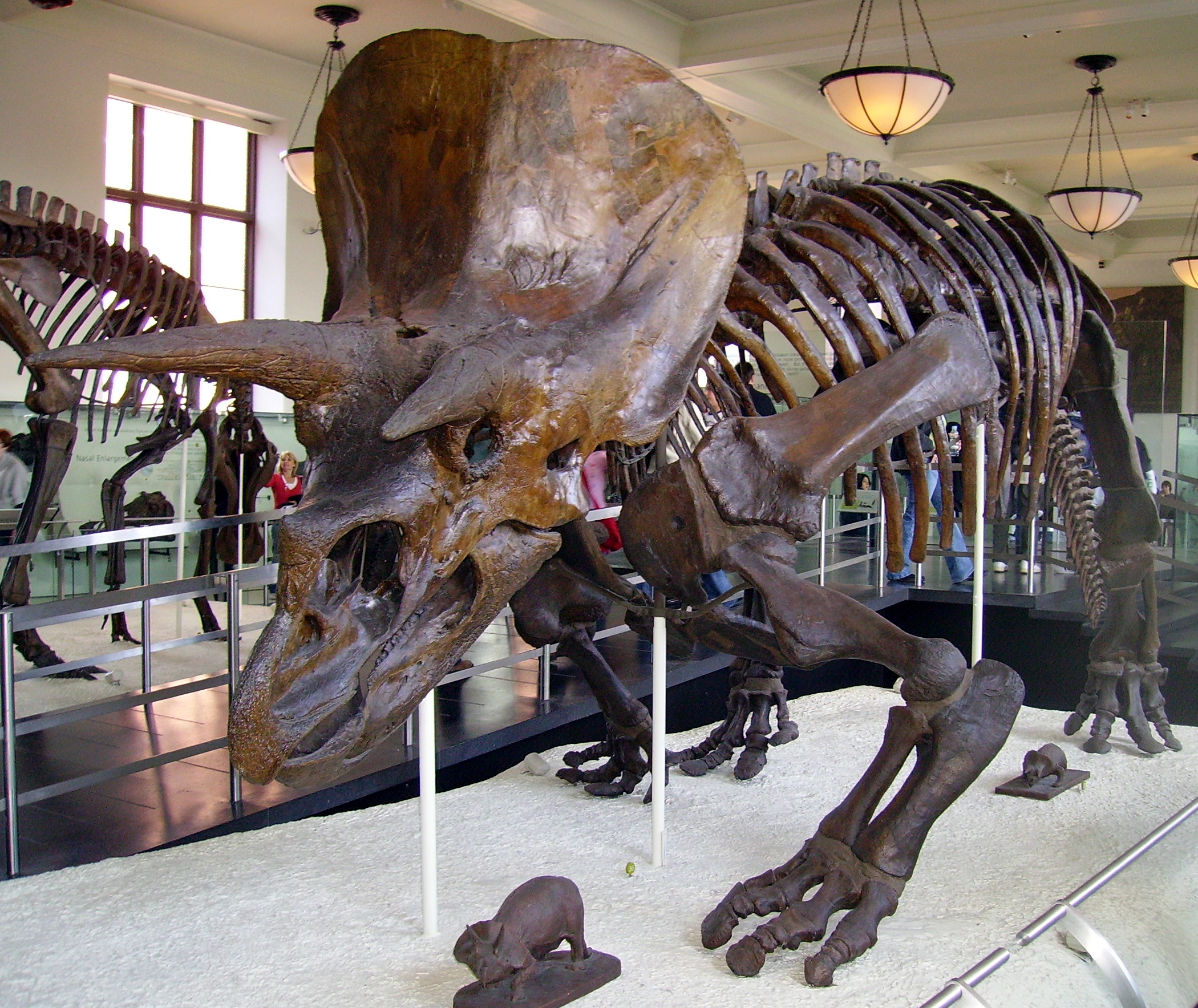
Triceratops (American Museum of Natural History)
Just over 200 million years ago — almost exactly 50 million years after the great Permian extinction in which more than 90 percent of all marine species and nearly three fourths of all terrestrial vertebrate species were expunged — a great extinction event marks the boundary between the Triassic and the Jurassic: the event which eventuated in the rise of the dinosaurs.
For 135 million years after the Triassic-Jurassic extinction, the dinosaurs were the dominant vertebrate species on the planet.
We almost certainly know the reason for the extirpation of the dinosaurs 65 million years ago (see tomorrow’s post), and we aren’t yet at all certain of the reason for the earlier Permian extinction. (At least three good possibilities are: massive volcanism; multiple asteroid or comet impacts; or – the one I find most intriguing — the catastrophic release of methane hydrates from the ocean floor. Perhaps it was a combination of any two, or all three, of these eventualities.) As for the end Triassic extinction, speculation has heretofore concentrated largely upon volcanism.
Now, in a study published in the Proceedings of the National Academy of Sciences, a team of scientists led by paleobiologist Jessica Whiteside has found strong evidentiary support for the hypothesis that “massive, widespread volcanic eruptions led to a spike in atmospheric carbon dioxide and other greenhouse gases that wiped out half of plant species and marked the end of the Triassic, one of the five great mass extinctions of Earth history.”
Moreover, “the team also established through the fossil record that the abrupt rise in atmospheric gases decimated crurotarsans [crocodile-like creatures], which had competed vigorously with the earliest dinosaurs during the Triassic. Thanks to the climatic catastrophe, those early, small dinosaurs were freed from their main competitors to become the dominant force in the animal world.”
For considerably more detail, see this press release from Brown University, or its near duplicate How Dinosaurs Rose to Prominence in Science Daily, and also Dinosaur Rise Linked to Volcanism in the BBC News.
(You’ll find the abstract of the PNAS article at Compound-Specific Carbon Isotopes from Earth’s Largest Flood Basalt Eruptions Directly Linked to the End-Triassic Mass Extinction.)
Update: Wired magazine produces an excellent recapitulation of this study in Dinosaurs Rode Volcanic Armageddon to Victory.
                                                 Crurotarsan-Pancrocodylia Diversity


http://haysvillelibrary.wordpress.com/2010/03/23/
http://www.wired.com/wiredscience/2010/03/triassic-jurassic-extinction-explained/

8 Lukisan Paling Terkenal di Jamannya

0

Saya mungkin salah satu dari banyak orang yang menyukai lukisan etnik, berbau alam dan juga lukisan yang mampu memberikan saya inspirasi ketika melihatnya. Meskipun kegunaan lukisan itu untuk dipajang di dinding, namun lukisan yang kita koleksi juga memiliki makna yang berbeda-beda disetiap pesan yang hendak disampaikannya.
“ Lukisan terbaik bagi saya adalah lukisan yang mamupu membuat seseorang mengerti maksud ataupun pesan yang ingin disampaikan seniman tersebut melalui gambar serta mampu menjadi daya tarik  tersendiri bagi banyak orang”
Nah, ada beberapa lukisan luar biasa yang saya kutip dari internet, teryata lukisan tersebut merupakan salah satu lukisan menarik yang pernah ada. Bukan hanya menarik saja ternyata lukisan tersebut juga mampu menjadi luksan terkenal di dunia pada jamannya. Berikut lukisannya:
1.Lukisan Mona lisa
Lukisan ini mungkin adalah salah satu lukisan terkenal di negara Perancis dan Hang Louvre di Paris. Lagi-lagi lukisan tersebut tidak lepas dari tangan dingin sang seniman yakni Leonardo Da Vinci. Hasil karyanya tersebut juga melegenda dan lukisan tesebut menjadi lukisan terkenal di dunia. Lukisan ini menggambarkan bagaimana seorang wanita memandang penampil dengan senyum misterius.
2.From The Lake
Lukisan ini menampilkan gelombang lembut dan juga riak danau George. From The Lake adalah hasil lukisan dari Georgia O’keefe dimana ia menghabiskan hari-harinya di danau George, New York.
3.Girl with a pearl earring
Lukisan yang menggambarkan potret polos seorang gadis dihari sebelum pernikahannya. Lukisan ini dilukis oleh seniman terkenal yakni Jan Vermeer.
4.The Kiss
Gustav Klimnt sang seniman lukisan The kiss yang dibuat pada tahun 1907. Lukisan ini menggambarkan ciuman yang sempurna dan dikelilingi oleh selimut emas dan ornamen lainnya.
5.Starry Nigt
Lukisan ini juga merupakan salah satu yang  paling dikenal di dunia. Karya Van Gogh ini merupakan lukisan yang mendeskripsikan emosi dari sebuah ketenangan di menara gereja. Perpaduan warnanya juga sangat mendukung untuk mengambarkan situasi malam.
6.Luncheon of the boating party
Lukisan hasil karya Pierre Auguste Renior ini merupakan salah satu lukisan yang mendeskripsikan sekelompok temannya yang sedang bersantai di balkn sepanjang sungai seine. Lukisan tersebut  dipercaya merupakan salah satu lukisan yang memberikan kesan hidup di setiap ruangan.
7. The Dream
Hasil karya Pablo Picasso ini mempelopori gerakan seni modern yan disebut sebagai kubisme dan secara luas kita juga bisa diakui sebagai artis yang paling penting pada abad 20.
8. Lukisan Napoleon Melintasi Alpen
Lukisan ini merupakan lukisan yang cukup mendunia, karya dari tangan dingin Jacques-louis David. Menggambarkan seorang Napoleon yang tengah menunggang Keledai.
gambar : www.unik.bloggermu.com,www.senbudsalsa.blogspot.com

Portrait of an Artist as a Young Woman

0

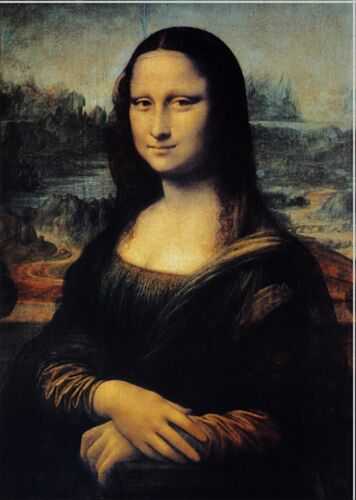
The world is a topsy-turvy place. In times of turmoil people turn to the old, the familiar, the classic, for assurance of continuity and stability. Ah, those halcyon days! Perhaps the newspaper is not a place to seek solace, but as I was flipping through the Friday edition, usually a little lighter after the dread of another week, I noticed a story about Leonardo da Vinci (before the code made him famous).


Self portrait or mirror?
For many centuries people have pondered the understated smile on the Mona Lisa’s placid yet knowing face. Recent forensic-type investigations are now strengthening the old suggestion that the Mona Lisa was actually a self-portrait of the artist as a woman. Some will, no doubt, find such news distressing – a masculine artist portraying himself as feminine? (Surely such a thing has never been done before!) Most concerned of all would be the Religious Right, a group that seeks a god excelling in sharp distinctions. Either male or female, no intersexuals need apply!
Over the past several months I have been reading Stephen Asma’s On Monsters, a book that can’t really be called “enjoyable,” although it has been eye-opening and informative. One of the recurrent themes throughout the book has been the fear of the liminal being conjoined with our growing understanding that sharp distinctions are rare. Ever since Freud it has been known (at least subconsciously) that people participate in aspects of both genders with social constructs determining which role is to be filled, feminine or masculine. Those who look honestly at the aggregate of the human race realize that we are all points on a continuum rather than simply members of one or the other gender. As Asma points out, however, we prefer distinctions.
In painting himself as a woman perhaps Leonardo once again proved himself ahead of his time. Perhaps the Mona Lisa is a mirror we should long gaze into before judging others on the basis of artificial distinctions

http://www.wikipaintings.org/en/leonardo-da-vinci/mona-lisa

Jason Mraz - I Won't Give Up

0


Hmmmm ... Hmmmm ... Hmmmm ... Hmmm ...

When I look into your eyes
It's like watching the night sky
Or a beautiful sunrise
There's so much they hold
And just like them old stars
I see that you've come so far
To be right where you are
How old is your soul?

I won't give up on us
Even if the skies get rough
I'm giving you all my love
I'm still looking up

And when you're needing your space
To do some navigating
I'll be here patiently waiting
To see what you find

'Cause even the stars they burn
Some even fall to the earth
We've got a lot to learn
God knows we're worth it
No, I won't give up

I don't wanna be someone who walks away so easily
I'm here to stay and make the difference that I can make
Our differences they do a lot to teach us how to use
The tools and gifts we got yeah, we got a lot at stake
And in the end, you're still my friend at least we did intend
For us to work we didn't break, we didn't burn
We had to learn how to bend without the world caving in
I had to learn what I've got, and what I'm not
And who I am

I won't give up on us
Even if the skies get rough
I'm giving you all my love
I'm still looking up
Still looking up.

I won't give up on us (no I'm not giving up)
God knows I'm tough enough (I am tough, I am loved)
We've got a lot to learn (we're alive, we are loved)
God knows we're worth it (and we're worth it)

I won't give up on us
Even if the skies get rough
I'm giving you all my love
I'm still looking up

JESSIE J - PRICE TAG

0

Seems like everybody's got a price
I wonder how they sleep at night
When the sale comes first and the truth comes second
Just stop for a minute and smile

Why is everybody so serious?
Acting so damn mysterious
You got your shades on your eyes and your heels so high
That you can't even have a good time

Everybody look to their left
Everybody look to their right
Can you feel that? Yeah
We'll pay them with love tonight

It's not about the money, money, money
We don't need your money, money, money
We just wanna make the world dance
Forget about the price tag

Ain't about the cha-ching, cha-ching
Ain't about the ba-bling, ba-bling
Wanna make the world dance
Forget about the price tag

We need to take it back in time
When music made us all unite
And it wasn't low blows and video hoes
Am I the only one gettin' tired?

Why is everybody so obsessed?
Money can't buy us happiness
Can we all slow down and enjoy right now
Guarantee we'll be feelin' alright

Everybody look to their left
Everybody look to their right
Can you feel that? Yeah
We'll pay them with love tonight

It's not about the money, money, money
We don't need your money, money, money
We just wanna make the world dance
Forget about the price tag

Ain't about the cha-ching, cha-ching
Ain't about the ba-bling, ba-bling
Wanna make the world dance
Forget about the price tag

Yeah, yeah, well, keep the price tag and take the cash back
Just give me six strings and a half stack
And you can keep the cars, leave me the garage
And all I, yes, all I need are keys and guitars

And guess what, in 30 seconds I'm leaving to Mars
Yes, we leaving across these undefeatable odds
It's like this man, you can't put a price on life
We do this for the love, so we fight and sacrifice every night

So we ain't gon' stumble and fall, never
Waiting to see, a sign of defeat, uh uh
So we gon' keep everyone moving their feet
So bring back the beat and then everybody sing, it's not about

It's not about the money, money, money
We don't need your money, money, money
We just wanna make the world dance
Forget about the price tag

Ain't about the cha-ching, cha-ching
Ain't about the ba-bling, ba-bling
Wanna make the world dance
Forget about the price tag

It's not about the money, money, money
We don't need your money, money, money
We just wanna make the world dance
Forget about the price tag

Ain't about the cha-ching, cha-ching
Ain't about the ba-bling, ba-bling
Wanna make the world dance
Forget about the price tag
Yeah, yeah Oh, forget about the price tag